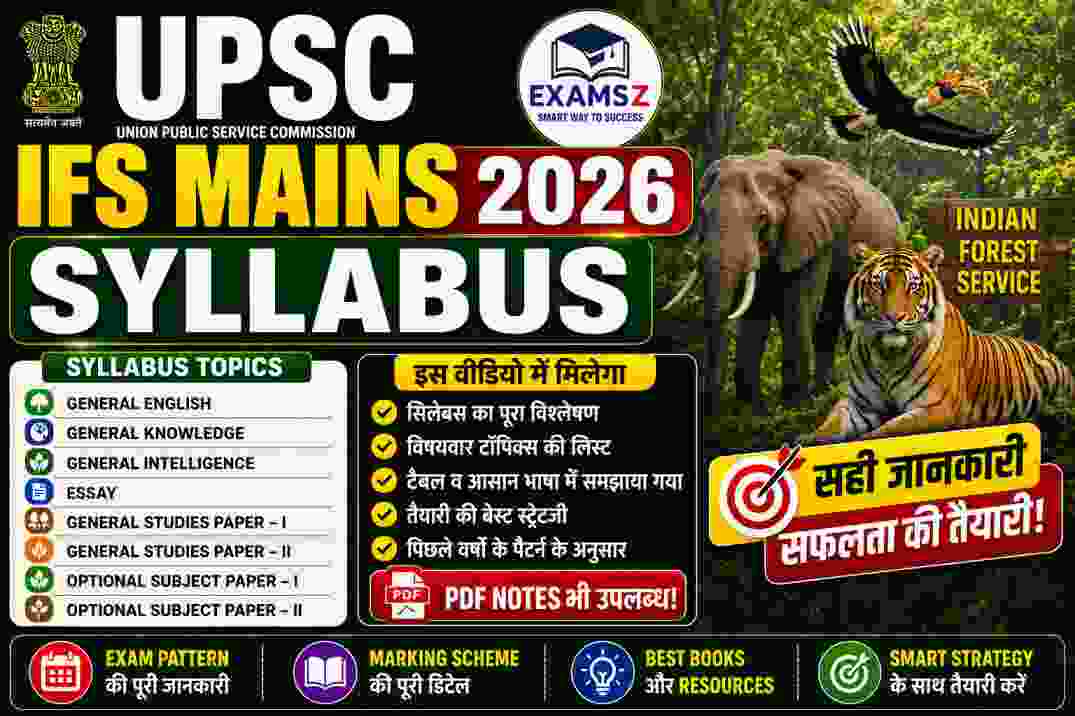
UPSC Indian Forest Service (IFS) Mains 2026 syllabus

The UPSC Indian Forest Service (IFS) Mains 2026 syllabus consists of six descriptive papers: General English, General Knowledge, and four papers from two optional subjects chosen by the candidate. Each paper is 3 hours long, conventional essay type, and carries significant weight in the final merit list.
📘 Exam Structure
- Paper I – General English (300 marks): Tests essay writing, comprehension, précis, grammar, and usage.
Paper II – General Knowledge (300 marks): Covers current events, everyday scientific observations, Indian Constitution, environment, sports, and general awareness.
Papers III–VI – Optional Subjects (200 marks each × 4 = 800 marks): Candidates select two optional subjects from a prescribed list (Forestry, Agriculture, Animal Husbandry, Veterinary Science, Chemistry, Physics, Mathematics, Botany, Zoology, Geology, Statistics, Civil Engineering, Mechanical Engineering, Chemical Engineering). Each subject has two papers.
Interview (Personality Test): 300 marks.
Total Marks: 1700.
📖 Detailed Syllabus
1. General English
Essay Writing: Long-form essay (800–1000 words) on one of several topics.
Short Compositions: Letters, reports, expansions of proverbs.
Précis Writing: Summarizing a passage to one-third length.
Comprehension: Answering questions based on unseen passages.
Grammar & Usage: Sentence correction, idioms, transformations (active/passive, direct/indirect speech), word formation, confusable words.
2. General Knowledge
Current Events: National and international importance.
Scientific Aspects: Everyday observations, environment, biodiversity, climate change.
Indian Constitution & Polity: Political system, rights issues, governance.
Geography & Economy: Physical, social, and economic geography; sustainable development; poverty; demographics.
Sports & Culture: General awareness of India and neighboring countries.
3. Optional Subjects (Choose Two)
Each optional subject has two papers (200 marks each). Some examples:
Forestry: Silviculture, forest soils, agroforestry, biodiversity, forest management, wildlife biology, forest economics, legislation.
Agriculture: Ecology, soil fertility, crop improvement, physiology, environmental pollution, water-use efficiency.
Animal Husbandry & Veterinary Science: Nutrition, physiology, livestock management, milk/meat technology, animal diseases, genetics.
Mathematics: Linear algebra, calculus, differential equations, numerical analysis, mechanics, fluid dynamics.
Physics: Classical mechanics, optics, relativity, quantum mechanics, electricity & magnetism, nuclear physics.
Chemistry: Atomic structure, thermodynamics, bonding, solid state, electrochemistry, kinetics, photochemistry, organic synthesis.
⚖️ Key Notes
All papers are descriptive and must be answered in English.
General English and General Knowledge are compulsory and count fully toward merit.
Optional subjects allow specialization, so candidates should choose based on their academic background.
The Interview (300 marks) evaluates personality, leadership, and suitability for forest service.
General English
General Knowledge
Optional Subjects
Interview (Personality Test)
Study Tips
Preparation Strategy:
- Create a study schedule
- Focus on high-weightage topics
- Practice previous year papers
- Take regular mock tests
Important Resources:
- NCERT books for basics
- Current affairs magazines
- Online practice platforms
- Join study groups